
Do you have abnormal tree growths on your leaves, twigs, or branches that cause concern? These may be tree galls, or abnormal, parasitic outgrowths of plant tissue similar to warts or benign tumors in animals.
Tree galls are swollen growths on tree branches, often mistaken for disease or fungi, that become more visible in late winter or early spring when trees are bare. Read on to learn more about what causes tree galls, where they appear, and if you need to worry about them.
What Causes Tree Galls?
Galls form as a reaction to insect feeding, mites, fungi, bacteria. New growth tissue swells and encases the invader. The walls of a gall are structurally strong, rich in protein, and provide the larvae inside with food and protection.
The most common culprits of insect galls are gall wasps, midges, aphids, and eriophyid mites.
Where Galls Show Up: Leaves, Twigs, Branches & Roots
Galls develop in spring and may persist through the growing season. They can appear in leaves, twigs, branches, and roots. Look out for these signs of tree galls:
- Leaves – Galls on tree leaves look like bumpy tree leaf blisters.
- Twigs & Branches – Galls appear as swollen growths on tree branches and twigs.
- Roots – Often appear underground and caused by nematodes or aphids.
Common Types of Tree Galls by Species
Oak and hackberry trees are the most susceptible to galls. Maples, elms, hickory, and willow trees are also commonly affected by tree galls. Here are some common types of galls by species:
- Oaks – Common galls on oak trees are oak apples and horned oak galls, which look like round, abnormal tree growths often on the underside of leaves and stems.
- Maples – Maple bladder galls appear as red, puffy growths on leaves
- Hickory – Hickory petiole galls appear as swollen growths at the base of leaf stems.
- Elm – Elm cockscomb galls are reddish growths that appear on leaf veins.
- Willow – Willow pinecone galls look like a pinecone at the stem tip.
Are Tree Galls Dangerous?
While tree galls don’t look very pretty, they rarely kill a healthy tree. If a younger or stressed tree has a heavy infestation of tree gall, it can distort growth and make them more susceptible to stress.
When to Call an Arborist
Certified arborists have the expertise to identify gall types and assess their long-term impact. If your tree is showing signs of repeated heavy infestations and dieback or limb damage, or if you have galls on high-value ornamental trees, contact your local arborist for an inspection.
Not sure if those growths on your tree are harmless or harmful? A certified Davey arborist can inspect and explain what’s normal and what needs attention this spring.
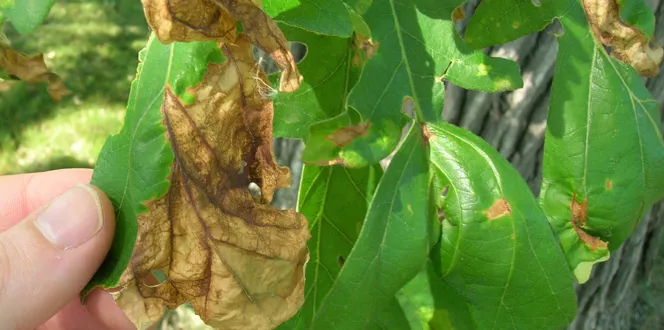
OAK LEAF BLISTER OR GALLS?
Tree Galls Explained: What Homeowners Need to Know This Spring
Galls on branches and twigs are more visible when trees are bare or dormant.
Oaks, maples, elms, hickory, and willow trees are most susceptible to tree galls.
If needed, you can prune infested twigs and branches at least 4 inches below the growth.. If needed, a licensed applicator may also provide chemical treatment for prevention of certain types of galls.
Galls are generally not harmful to healthy, mature trees.


Related Blog Posts

Hidden Storm Damage in Trees: Long-Term Risks & Preventative Care Tips